Machine Mobility and Transport Requirements for Stone Crusher Equipment
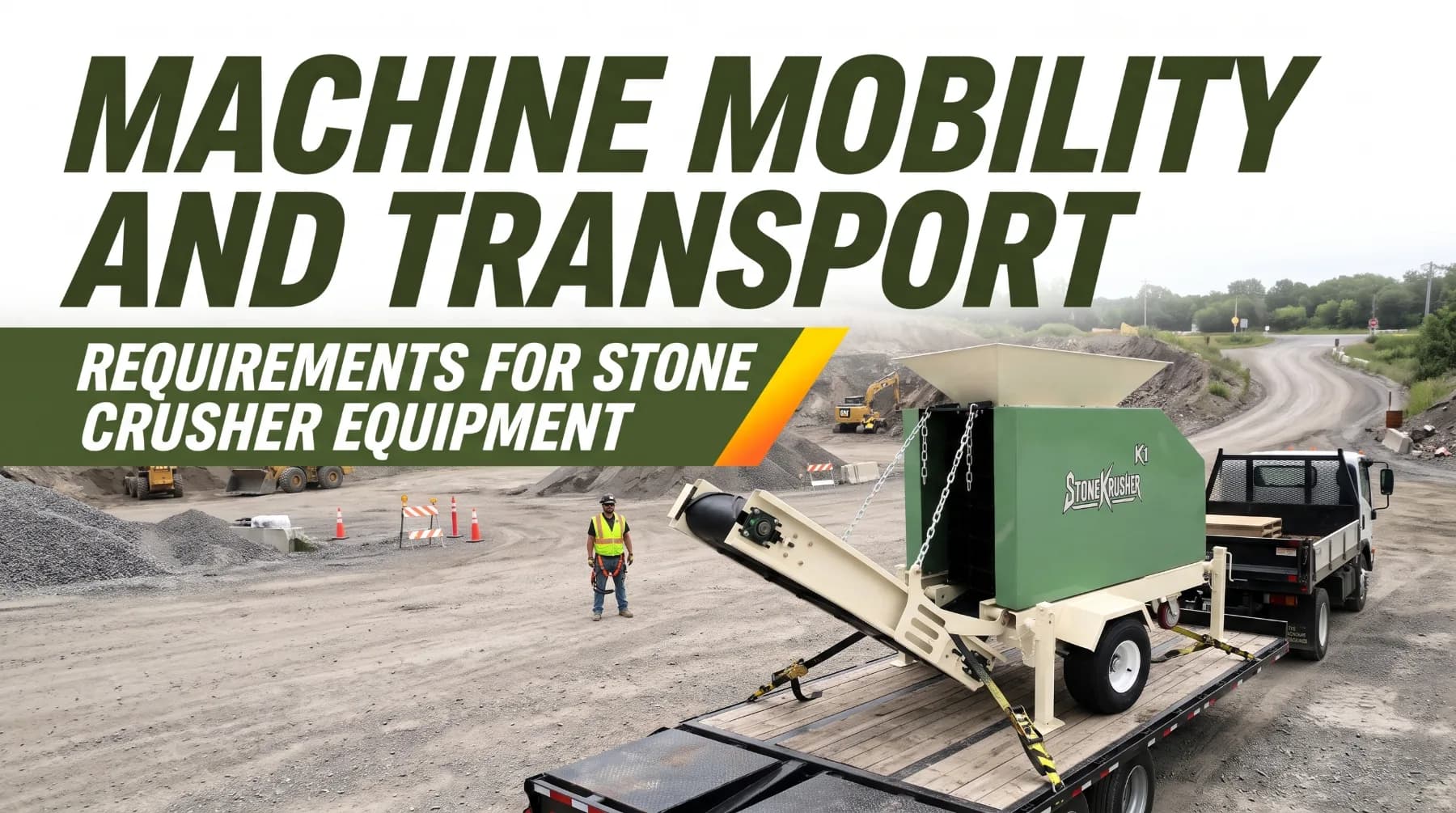
Stone crushers rarely stay in one place for long. A quarry may move its crushing plant closer to an advancing face. A demolition contractor may need to process concrete on one site this month and on another across the county next month. A road builder may run a crusher at several points along a corridor so aggregate is produced near where it will be used. Each move takes careful planning, because stone crushing equipment is among the heaviest, tallest, and most awkward machinery on any jobsite.
Moving a crusher well protects the equipment, the transport crew, and everyone who shares the site or the road. Moving one poorly can cause serious harm. An underestimated height can strike a bridge or an overhead power line. A trailer with too little capacity can fail under load. A crusher traveling over soft ground can sink, tilt, or tip. Missing permits can stop a load at the roadside, bring fines, and delay the whole project. Conveyors or hoppers left unsecured can shift during travel and damage the machine or other vehicles.
Successful transport depends on a few connected factors: accurate dimensions and weight, a clear understanding of how the machine moves, a route that can handle the load, correct loading and securing, compliance with road and permit rules, and a disciplined preparation routine before anything moves.
Machine Dimensions and Weight
Every transport plan starts with accurate numbers. Before choosing a trailer, mapping a route, or applying for a permit, confirm exactly how large and how heavy the crusher will be in its transport configuration.
Use the manufacturer's specifications for the exact model and configuration. Most specification sheets list transport dimensions separately from working dimensions, because crushers are designed to fold, retract, or lower components for travel. Working figures do not reflect the transport profile, and transport figures for a similar model may not match your machine.
Optional equipment and modifications change the numbers too. Magnets, dust suppression systems, extended conveyors, additional screen decks, and aftermarket attachments can add weight or change dimensions. Keep a record of the machine's actual configuration, and measure the loaded unit where any doubt exists.
Material left in the machine adds weight as well, especially when handling construction materials. Rock lodged in the crushing chamber, fines packed into hoppers and conveyors, and buildup on the frame can add significant mass that does not appear on any specification sheet. Clearing material before transport, covered later in this guide, keeps the actual weight close to the documented figure.
These measurements determine whether the equipment can travel on the planned route and transport vehicle. They feed directly into trailer selection, route planning, overhead clearance checks, and permit applications. An error at this stage carries through every step that follows.
Key takeaway: Confirm the crusher's transport length, width, height, and weight using the manufacturer's specifications for the exact configuration, include all attached components such as conveyors, hoppers, and stabilizers, and account for optional equipment and retained material.
Access Routes and Ground Conditions
A crusher can only move as far as the route allows. Before any repositioning or transport, walk and assess the full route, from the machine's current position to its destination. This includes the path to the loading point and the path from the unloading point to the new working location.
Check the following along every section of the route:
- Route width: Compare the narrowest point with the crusher's full transport width, and allow working clearance on each side. Include gates, haul roads, ramps, bridges, and gaps between stockpiles or structures.
- Turning areas: Long crushers and trailer combinations need wide turning radii. Confirm that every corner, junction, and site entrance can accommodate the full length of the machine or load.
- Overhead clearance: Identify power lines, telephone and data cables, conveyor gantries, pipe racks, tree limbs, signage, and structures. Measure clearance against the total load height, including the trailer deck where applicable.
- Slopes and grades: Compare grades with the manufacturer's permitted travel limits. Steep grades increase stopping distances, place heavy loads on tracks and brakes, and raise the risk of sliding or tipping, especially on side slopes.
- Surface strength: Confirm that the ground can carry the machine's weight. Soft soil, recently placed fill, saturated ground, culverts, buried pipes, drainage structures, and thin paving can fail under concentrated loads.
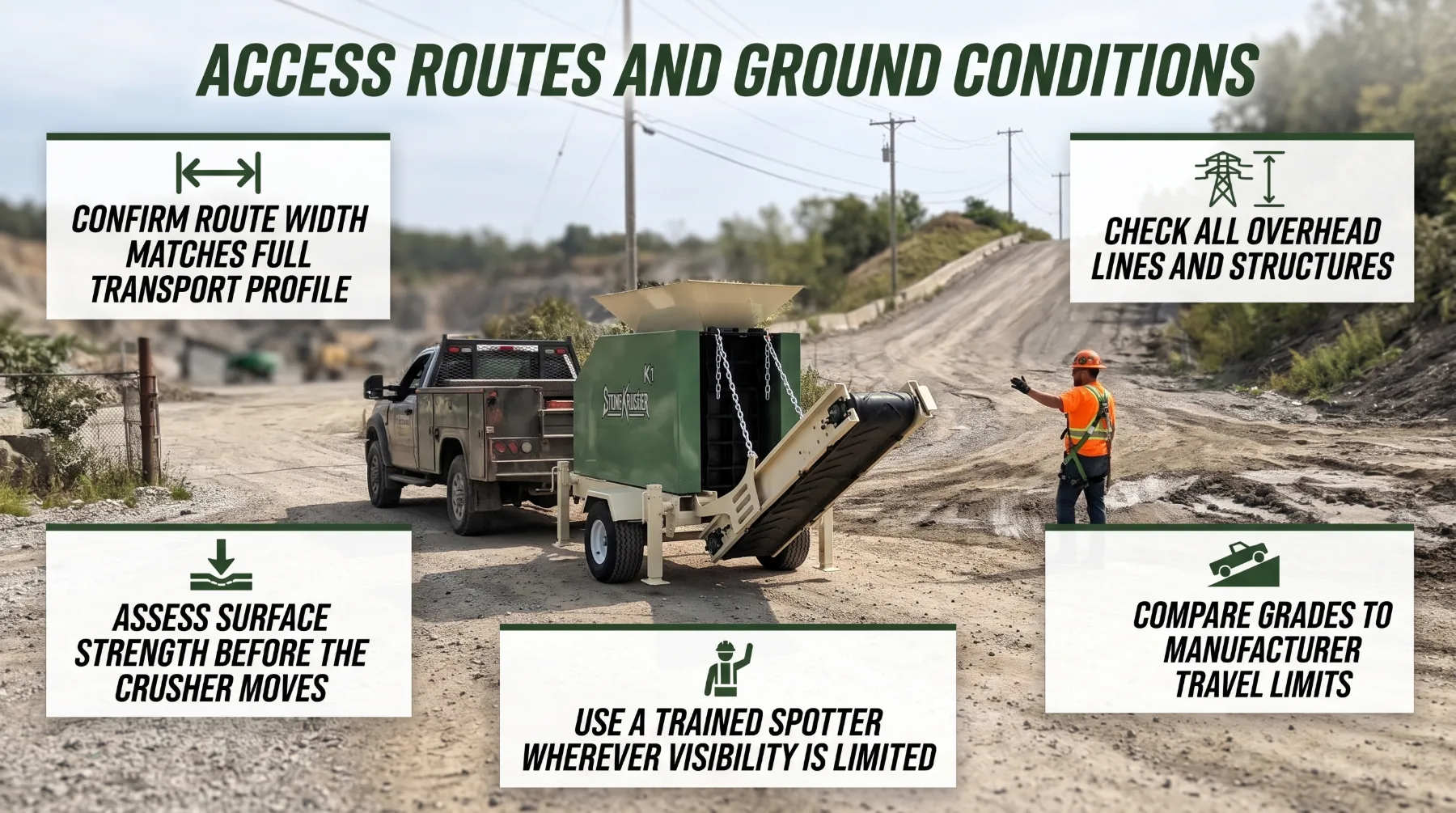
Soft ground or uneven surfaces can affect stability during repositioning. A tracked crusher crossing a rut or soft patch can tilt suddenly, and its high center of gravity makes it sensitive to side slopes. A wheeled crusher can sink or bog down where the surface cannot carry its axle loads.
Keep the travel route clear of workers, utilities, and other equipment. Establish an exclusion zone around the moving machine that covers its full width and the area ahead of and behind it. Brief everyone on site about the planned move, its timing, and the areas that will be off limits. Use a trained spotter wherever visibility is limited. The spotter must stay in a safe position outside the travel path, remain visible to the operator, and use signals agreed before the move begins.
Buried services need attention as well. Heavy crushers can damage shallow utilities beneath haul roads and unpaved routes. Confirm utility locations where the route crosses unfamiliar ground, and plan crossings that protect marked lines.
For tracked machines driven by remote control, the operator should walk at a safe distance and in a safe position relative to the machine. Never walk directly in front of or behind a moving crusher, or in any position where a slip, slide, or sudden movement could trap a person.
Key takeaway: Walk the full route before moving the crusher, check width, turning areas, overhead clearance, slopes, and surface strength, repair or reinforce weak sections, and keep the route clear of workers, utilities, and other equipment throughout the move.
Mobility Configuration
Stone crushers move in different ways, and the mobility configuration shapes every part of the transport plan. Understanding how a particular machine is designed to move helps the crew choose the right method for each stage of the journey.
Tracked machines travel slowly, and they are usually driven by a remote control or an operator station. The operator must keep a clear view of the machine and its path while staying at a safe distance from the tracks and travel route. Tracks can damage paved surfaces, so ground protection may be needed on finished areas. Track condition, tension, and travel motor performance all affect how safely the machine can move.
Wheeled or towed machines depend on the condition of their tires, axles, brakes, lights, and coupling. The towing vehicle must be rated for the load and correctly matched to the crusher's hitch arrangement. Wheeled units typically need firmer travel surfaces than tracked machines and may have limited ability to cross soft ground or steep grades.
Skid-mounted and modular equipment relies entirely on lifting and loading equipment. Crane capacity, rigging, lifting points, and the stability of the ground beneath the crane become central to the plan.
The mobility system determines how the machine can be repositioned, but it does not automatically authorize public-road travel. A tracked crusher may move freely across a quarry floor, yet it almost always requires a trailer to travel on public roads. A wheeled crusher with a road-tow chassis may still need permits, escorts, and specific lighting and braking equipment to travel legally. Never assume that the ability to move means the ability to travel on the road.
Distinguish clearly between on-site movement and public-road transport in the plan. On-site movement follows site rules, route checks, and the manufacturer's travel instructions. Road transport adds trailer requirements, driver qualifications, securing standards, and regulatory compliance.
Key takeaway: Identify whether the crusher is tracked, wheeled, towed, or skid-mounted, plan each stage of the move around that configuration, and remember that the machine's mobility system never authorizes public-road travel on its own.
Road and Permit Requirements
Public-road transport brings stone crushers under a separate set of rules. Most crushers exceed the standard legal limits for width, height, length, or weight, which means they travel as oversize or overweight loads. Planning for these requirements early prevents delays, fines, and unsafe conditions on the road.
In the United States, legal limits vary by jurisdiction, but common thresholds include a vehicle width of 8 feet 6 inches and a gross vehicle weight of 80,000 pounds on the Interstate system. Height and length limits vary more widely from state to state. Loads that exceed the applicable limits generally require special permits, and many crusher moves exceed more than one limit at once.
Permits often specify the exact route, travel times, and conditions of the move. Deviating from the permitted route can lead to fines and may take the load onto roads or bridges that cannot carry it. Keep permits and route documents in the towing vehicle and follow them exactly.
Allow time for the permit process. Permit approval can take anywhere from a few hours to several weeks, depending on the load's size, the jurisdictions involved, and whether engineering reviews of bridges or routes are required. Superloads, the heaviest and largest oversize moves, often need the longest lead times.
Confirm applicable requirements before scheduling transport rather than assuming a mobile crusher can travel on the road independently. Even a crusher designed with a road-tow chassis must meet the requirements that apply to its weight, dimensions, braking, and lighting.
Compliance protects more than the transport company. It protects other road users, public infrastructure, and the reputation of every business involved in the move.
Key takeaway: Treat most crusher moves as oversize or overweight loads, confirm trailer, driver, route, permit, escort, and signage requirements for every jurisdiction before scheduling transport, and follow permitted routes and travel times exactly.
Loading and Securing for Transport
Loading a crusher onto a transport vehicle is one of the highest-risk stages of any move. The machine is heavy, often top-heavy, and it must travel up ramps or be lifted into position with little room for error. Once loaded, it must stay secure through braking, cornering, vibration, and uneven road surfaces.
Use the manufacturer's designated lifting or loading points and approved loading procedure. Crushers are engineered with specific points for lifting, towing, and securing. Using any other point, such as a conveyor frame, handrail, walkway, or hydraulic component, can damage the machine and cause a load to drop or shift.
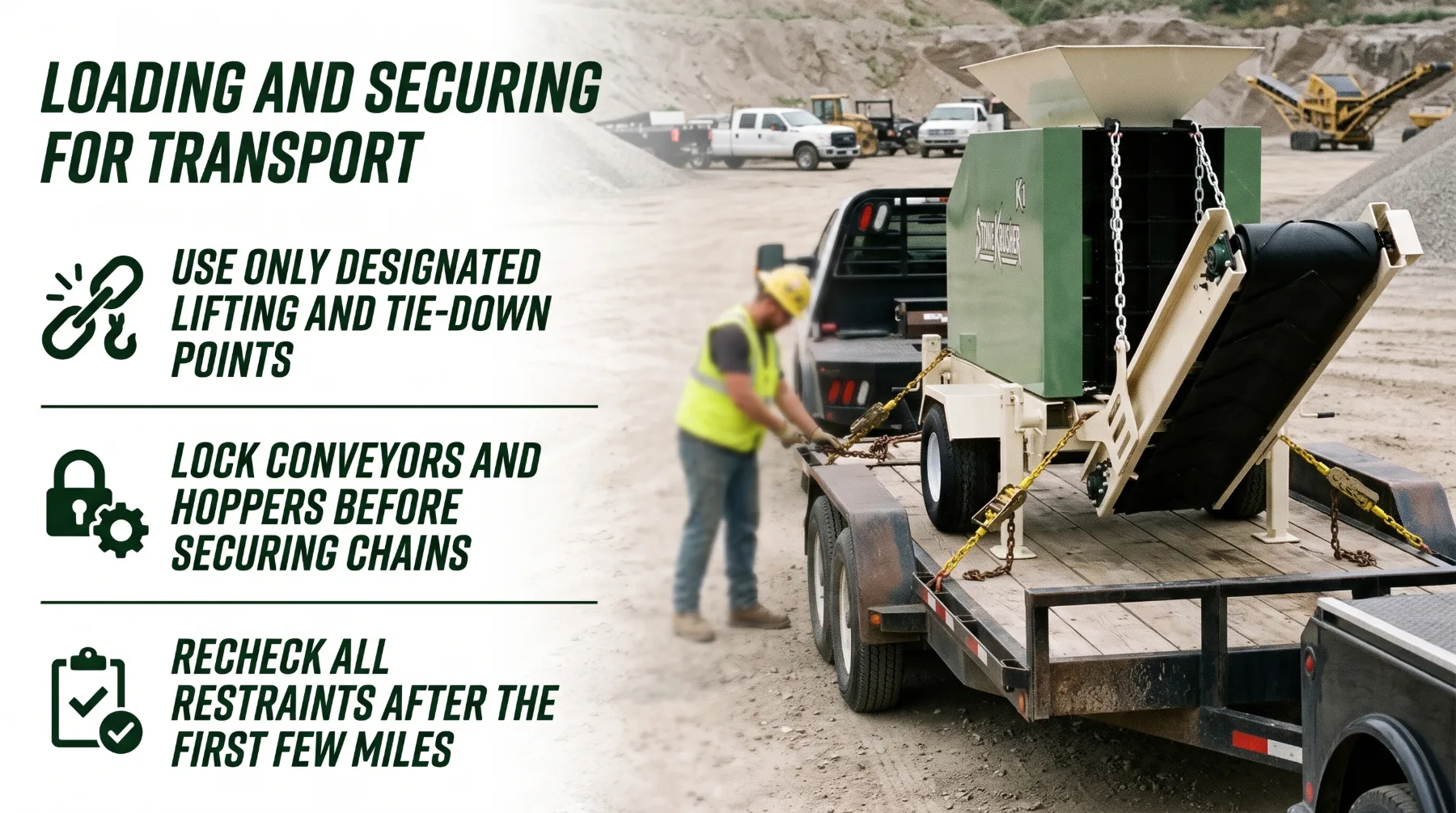
Select a transport vehicle with adequate capacity and suitable dimensions. The trailer must be rated for the crusher's transport weight, with enough deck length and width to carry the machine without excessive overhang. Lowboy or low-loader trailers are common for tracked crushers because their low deck height helps keep the total load height within limits. Confirm that axle ratings, gooseneck capacity, and the towing vehicle's rating all suit the load.
Load slowly and deliberately. Align the machine squarely with the trailer and ramps before starting. Travel at the lowest practical speed, and use a trained spotter who stays in a safe, visible position. Watch for the moment the machine's weight shifts as it crosses the ramp crest onto the deck, since tracked machines can tip forward suddenly at this point. Stop immediately if the machine begins to drift off line, and correct its position before continuing.
Confirm that all transport restraints are in place before departure. Walk around the load and check every tie-down, locking pin, and component restraint. Recheck restraints after the first few miles of travel and at regular stops, since chains and straps can loosen as the load settles.
Key takeaway: Use only the manufacturer's designated lifting, loading, and tie-down points, select a trailer rated for the crusher's weight and dimensions, load slowly with a spotter and a clear zone, and confirm every restraint is secure before departure and during the journey.
Preparation Before Moving
A disciplined preparation routine ties the entire transport plan together. Most transport problems, from shifting components to brake failures, can be prevented by a thorough check before the machine moves even a few feet.
Secure conveyors and movable components next. Fold, lower, or retract conveyors, hoppers, hopper extensions, stabilizers, and side discharge units into their transport positions using the manufacturer's procedure. Insert every locking pin, transport bracket, and restraint the manufacturer requires. Confirm that hydraulic cylinders holding components in position are supported mechanically where the procedure calls for it, rather than relying on hydraulic pressure alone.
Follow the machine's transport checklist. Most manufacturers provide a specific list of steps for preparing the crusher for travel. Work through it in order and record its completion. A typical pre-move inspection includes:
- Tires or tracks: Check for cuts, wear, damage, and correct inflation or track tension. Inspect sprockets, rollers, and idlers on tracked machines.
- Brakes, where fitted: Test service and parking brakes on wheeled and towed units, and confirm brake connections to the towing vehicle work correctly.
- Lights and signals: Confirm that transport lights, brake lights, turn signals, and warning beacons function.
- Transport connections: Inspect the kingpin, fifth-wheel connection, hitch, safety chains, and electrical and air connections on towed units.
- Hydraulic components: Inspect hoses, fittings, and cylinders for leaks, abrasion, and damage. Use a piece of cardboard rather than your hand to check for leaks, since pressurized fluid escaping from a pinhole leak can penetrate the skin and cause serious injury.
- Guards and covers: Confirm all guards, panels, and access doors are closed and secured.
- Loose items: Remove or secure tools, spare parts, and anything stored on the machine that could fall during travel.
- Fluid levels: Check engine oil, hydraulic fluid, coolant, and fuel according to the manufacturer's procedures, and look for drips beneath the machine.
Report any defect that affects safe movement, and keep the machine stationary until it has been corrected.
Keep personnel clear during loading, unloading, and repositioning. Brief everyone involved before the move begins, covering the route, the sequence of steps, communication signals, and each person's role. Assign one person to direct the move, and confirm that everyone else knows where to stand. Workers should never be in front of or behind a moving crusher, beside loading ramps, or beneath a suspended load.
After the move, reverse the process carefully at the destination. Confirm that the new working area has firm, level ground and clear overhead space before setting up. Remove transport restraints in the order the manufacturer specifies, deploy components according to the setup procedure, and complete a full pre-operation inspection before crushing resumes.
Key takeaway: Stop crushing operations, clear material, and secure conveyors and movable components before moving, work through the manufacturer's transport checklist, inspect tires or tracks, brakes, lights, connections, and hydraulics, and keep personnel clear throughout every stage of the move.
Conclusion
Stone crusher transport requires accurate weight and dimension checks, a suitable mobility method, and proper loading and securing. Confirming transport dimensions and weight from the manufacturer's specifications, including every attached conveyor, hopper, and stabilizer, gives the crew the reliable numbers every other decision depends on. Understanding whether the machine is tracked, wheeled, towed, or skid-mounted shapes how it moves on site, while reinforcing that mobility alone never authorizes road travel. A walked and assessed route, with confirmed width, turning space, overhead clearance, grades, and ground strength, keeps repositioning stable and controlled. Designated lifting and tie-down points, a properly rated trailer, and careful loading keep the crusher secure from departure to arrival. Early attention to permits, escorts, and route restrictions keeps oversize moves compliant and on schedule. A thorough preparation routine, from stopping the feed and clearing material to inspecting brakes and checking hydraulics with cardboard, catches problems before they reach the road.
Each of these steps supports the next. When you plan the route and transport configuration in advance, follow the manufacturer's procedures, and treat every move with the same discipline as daily operation, you reduce delays, prevent equipment damage, and get your crushing equipment to the next job ready to produce.
FAQs
Can a tracked stone crusher travel on public roads?
Not automatically. Public-road movement depends on the machine's design, transport configuration, and applicable regulations. Tracked crushers are built to travel under their own power on site, but they almost always need to be loaded onto a suitable trailer for road transport. Their size and weight usually make them oversize or overweight loads, which require permits, a qualified driver, and in many cases escorts and route restrictions.
What dimensions should be checked before transport?
Confirm overall length, width, height, weight, and any attached components that affect the transport profile. Use the manufacturer's transport specifications for the exact configuration, and include conveyors, hoppers, stabilizers, screens, and optional equipment. Add the trailer deck height to the machine height to find the total load height, and check axle or support loads against trailer and road limits.
Can a crusher be loaded using any lifting point?
No. Use only designated lifting points and approved procedures. Crushers have specific points engineered for lifting, towing, and tie-down. Lifting from conveyor frames, walkways, handrails, or hydraulic components can damage the machine and cause the load to drop or shift. Follow the operator's manual for lifting points, rigging requirements, and tie-down locations.
Why is route planning important?
The route must accommodate the equipment's dimensions, turning needs, ground conditions, and overhead clearance. A route that looks clear can hide narrow gates, tight corners, low power lines, soft ground, or weak culverts. On public roads, bridges and overpasses may have height or weight limits, and permits often specify the exact route. Walking and documenting the route before the move prevents strikes, sinking, delays, and permit violations.
Need Equipment Help?
Turn the article into a buying decision with product guidance, attachment fit checks, and quote support.