Wheel Loader Steering Angle Explained: How It Affects Maneuverability
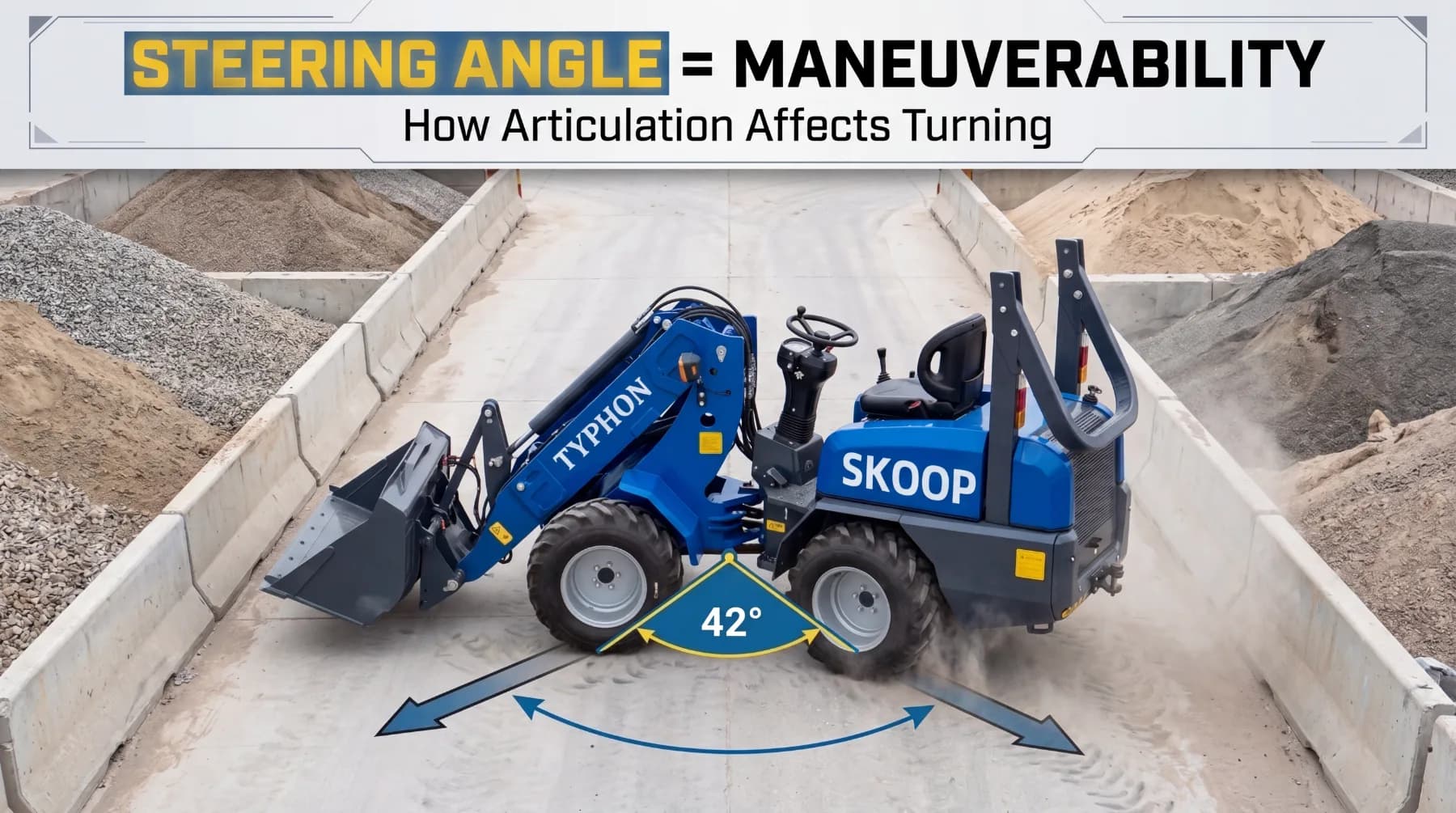
The steering angle doesn't get the attention of horsepower or bucket capacity, yet it quietly decides how well a wheel loader works in the real world. It's the specification that tells you how sharply the machine can turn, and that turning ability shapes everything from how you load a truck to how you thread between stockpiles on a crowded site. A loader with strong articulation moves confidently through tight spaces, repositions quickly, and wastes little time maneuvering into place. One with a limited steering angle leaves you backing up, inching forward, and fighting for room on every pass. This post breaks down what steering angle actually means, how it affects turning radius and jobsite access, how it changes the way the bucket moves through a turn, how maneuverability balances against stability, and how to choose the right steering angle for your work. With this understanding, you can pick a machine that fits your sites and get dependable performance every day.
What Steering Angle Means
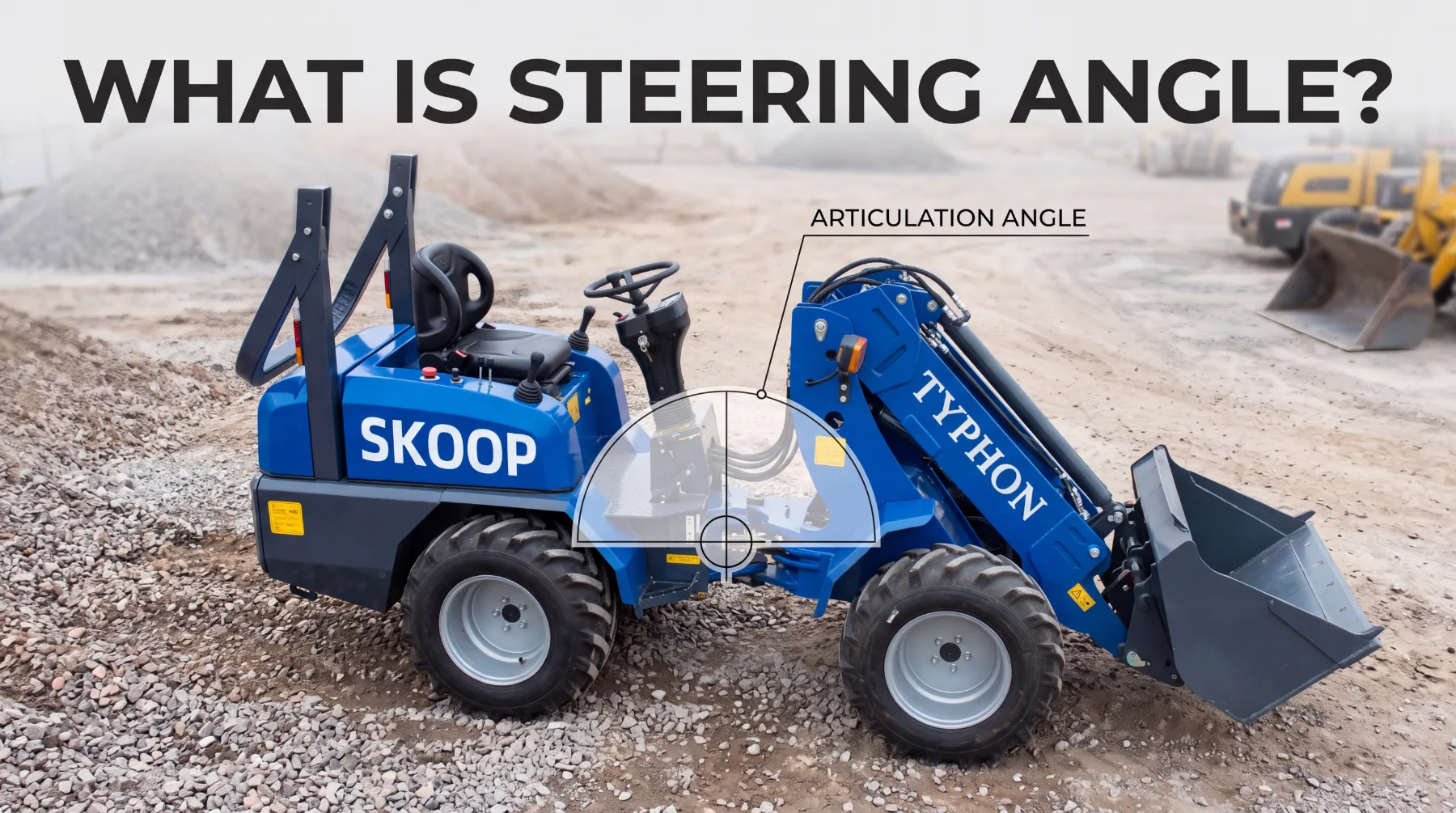
Steering angle describes how far a wheel loader's articulated frame can pivot when the machine turns. Most wheel loaders use articulated steering, meaning the machine is built in two halves joined by a central pivot point. Instead of turning the front wheels like a car, the loader bends at that joint, swinging the front section left or right relative to the rear. The steering angle is the maximum degree of that bend, and it tells you directly how sharply the machine can change direction.
A greater steering angle allows the loader to make tighter turns in limited spaces. When the frame articulates further, the front and rear sections form a sharper angle, which pulls the machine around a smaller arc. This is why articulation matters so much on confined jobsites. A loader that pivots to a wide angle can swing its bucket toward a target while keeping the whole machine within a modest footprint, something a stiffer, straighter-steering machine simply can't manage.
Understanding this pivot helps you read a spec sheet with a clearer eye. Two loaders of similar size and power can behave very differently based on their steering angles alone. The numbers reveal how the machine will actually feel on the job:
- Total articulation — the combined left-and-right pivot range that defines turning sharpness.
- Frame design — how the two sections are joined and how far they can safely swing.
- Turning behavior — how the whole machine responds when the operator commits to a turn.
Reading steering angle as the machine's turning capability, rather than an abstract figure, helps you judge whether a loader will maneuver comfortably in the spaces where you actually work.
Turning Radius and Jobsite Access
A larger steering angle translates directly into a smaller turning radius, and that relationship is where articulation proves its value. Turning radius describes the size of the circle the loader needs to complete a turn. When the frame articulates to a sharper angle, the machine swings around a tighter arc, which means it needs less open space to change direction. On sites where room is scarce, that difference decides whether the loader works smoothly or struggles at every turn.
The practical benefit shows up in how easily the machine navigates a busy jobsite. Loaders rarely operate on open ground; they work among buildings, stockpiles, parked trucks, and other equipment, all of which limit the space available to maneuver. A loader with a tight turning radius can pivot around these obstacles without repeated back-and-forth adjustments, keeping the work moving instead of stalling while the operator repositions.
Better access improves the whole loading cycle in several ways:
- Working around stockpiles — the loader circles material and lines up for the next scoop without wide swings.
- Loading trucks efficiently — a tight radius lets the machine approach and pull away from a truck cleanly.
- Navigating confined sites — the loader threads between structures and equipment where a wider-turning machine would jam up.
On production work, the loading cycle repeats hundreds of times a day, and every unnecessary maneuver adds up. A machine that turns tightly shortens each cycle, reducing the time spent positioning between the pile and the truck. Over a full shift, that efficiency means more loads moved and less fuel burned on wasted motion. For contractors who work in tight yards, quarries, or urban sites, a strong steering angle and the smaller turning radius it delivers directly shape how productive the machine feels day after day.
Bucket Position During Turns
Steering angle affects not just where the machine goes, but how the bucket travels through a turn, and that movement matters more than many operators realize. Because an articulated loader bends at its center, the front section and the bucket swing along a different path than the rear during a turn. The bucket moves outward and around as the frame pivots, tracing an arc that the operator must anticipate to place material accurately and avoid striking nearby obstacles.
Understanding this movement helps operators work with precision. When approaching a truck, a hopper, or a specific spot on a pile, the operator has to account for how the bucket will swing as the machine articulates into position. A loader with a strong steering angle brings the bucket around more sharply, which is an advantage when lining up in tight quarters, but it also means the operator must judge the bucket's path carefully to release material exactly where it belongs.
Obstacle awareness ties closely to this behavior. As the front section swings during a turn, the bucket and the front of the machine sweep through space that the operator needs to keep clear. Knowing how far and how sharply the bucket travels helps the operator avoid contact with truck sides, walls, stockpiles, and other equipment that crowd a typical jobsite. An experienced operator uses the articulation to their advantage, swinging the bucket into position with a single smooth motion rather than a series of corrections.
This is why familiarity with a machine's steering behavior pays off. Operators who understand how their loader's frame and bucket move through a turn position material faster, protect the equipment and surroundings from accidental contact, and complete each cycle with greater confidence. The steering angle sets the character of that movement, and reading it well turns articulation into accurate, efficient loading.
Maneuverability vs. Stability
A tight turning radius clearly improves maneuverability, but it should never be considered in isolation. Articulated loaders present a specific stability consideration precisely because they bend in the middle. When the frame is turned to a sharp angle, the machine's center of gravity shifts relative to its wheels, which can reduce stability, especially when the bucket is raised and loaded. A loader that feels planted while driving straight can become noticeably less stable when articulated hard with a heavy load lifted high.
This means operators have to weigh several factors whenever they turn with a loaded bucket. Load position plays a major role, since a raised load sits higher above the ground and exerts more leverage against the machine's balance. Keeping the bucket low during turns lowers the center of gravity and helps the loader stay steady. Ground conditions matter just as much, because turning sharply on a slope, on soft ground, or across uneven terrain can push a machine toward instability that would never occur on level, firm ground.
Several considerations deserve attention every time the operator turns under load:
- Load position — carry the bucket low during turns to keep the center of gravity down.
- Ground conditions — slopes, soft surfaces, and uneven terrain reduce stability during articulation.
- Travel speed — turning sharply at speed increases the risk of tipping, so slowing down protects the machine.
- Travel speed brings these factors together. Making a sharp articulated turn at higher speed combines the shifted center of gravity with momentum, a combination that raises tipping risk considerably. Slowing down before a tight turn gives the operator control and keeps the machine safely within its stable range. The goal is to enjoy the maneuverability a strong steering angle provides while respecting the physics of an articulated frame. Operators who balance quick, tight turning against load, ground, and speed get the best of both, working efficiently in tight spaces without compromising safety.
Choosing the Right Steering Angle
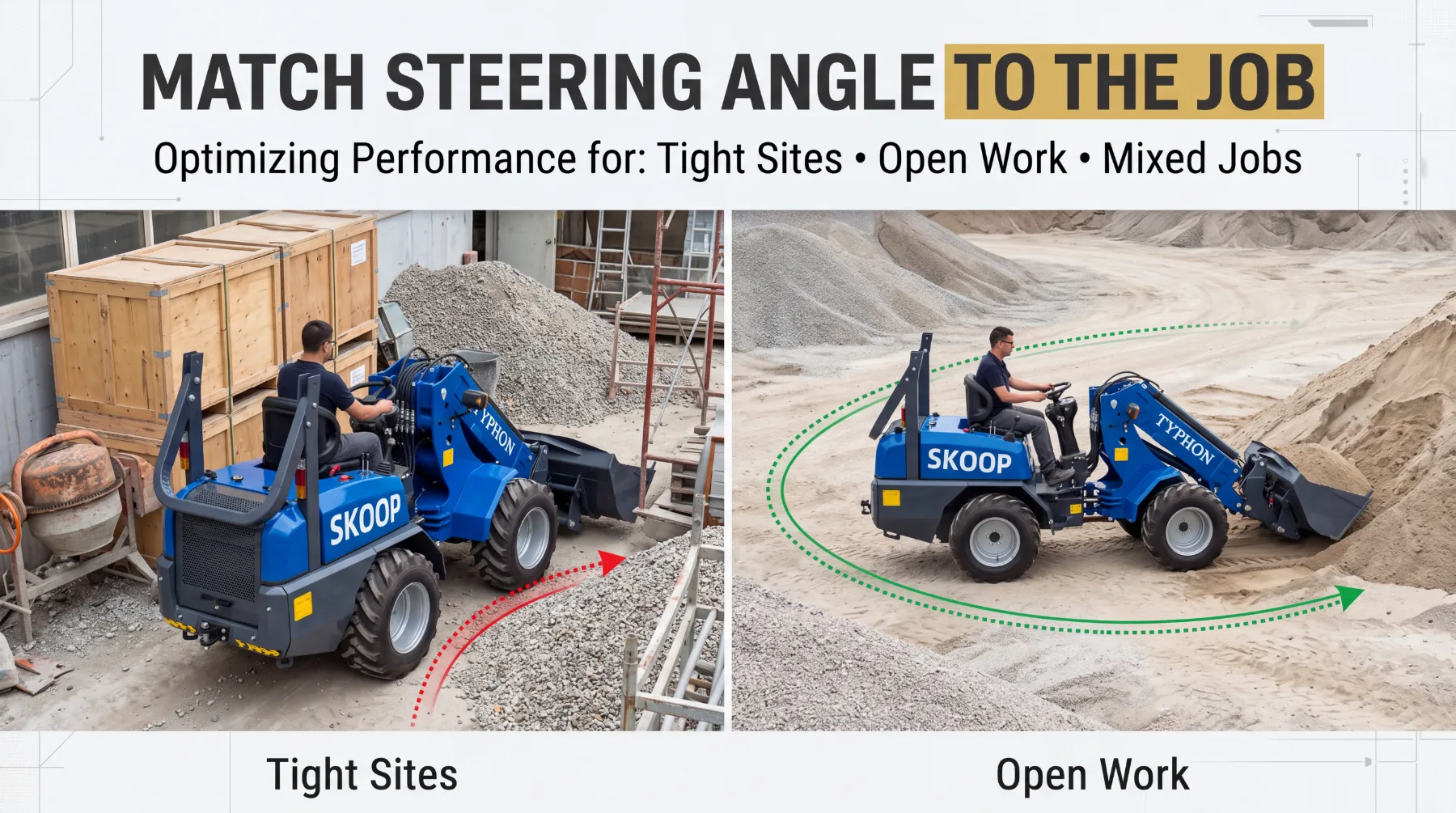
There's no single ideal steering angle, because the right amount of articulation depends on the loader's size and the work it's built to do. A machine's steering capability should match the spaces it operates in and the tasks it handles most often. Choosing well means thinking about where the loader will spend its working life, not just chasing the sharpest turning figure on a spec sheet. A strong steering angle serves some operations beautifully and offers little advantage to others.
Jobs in confined areas generally benefit most from strong articulation and tight turning capability. Urban construction, tight equipment yards, indoor or walled sites, and dense stockpile operations all reward a loader that can pivot sharply and reposition in minimal space. In these settings, a machine that turns tightly loses less time to maneuvering and works safely close to obstacles, which is exactly what cramped conditions demand. For contractors whose work happens in tight quarters, articulation is a specification worth prioritizing.
Different applications point toward different priorities:
- Confined sites — favor strong articulation for tight turns and easy repositioning around obstacles.
- Open production work — may value stability, capacity, and travel speed over maximum turning sharpness.
- Mixed operations — benefit from a balanced machine that handles both open ground and tight spaces well.
Loader size factors in as well, since larger machines naturally operate in more open settings while compact loaders are chosen precisely for their agility in tight spaces. Matching the steering angle to the machine's role keeps the whole package sensible. The best approach is to consider the sites you work most often, the obstacles you navigate, and the loading cycles you repeat, then choose a loader whose articulation aligns with those realities. A steering angle matched to your work delivers efficient maneuvering where you need it and dependable performance across every shift.
Conclusion
Steering angle shapes far more of a wheel loader's real-world performance than its modest place on the spec sheet suggests. It defines how sharply the articulated frame pivots, how tight a turning radius the machine can achieve, and how easily the loader navigates the crowded conditions of a typical jobsite. It also governs how the bucket travels through a turn, which directly affects loading accuracy and obstacle awareness. Just as important, a strong steering angle must be balanced against stability, load position, ground conditions, and travel speed to keep the machine safe under load. No single number tells the whole story, which is why steering angle should be considered alongside the loader's size and intended application. By understanding how articulation ties into the rest of the machine, you can choose a wheel loader that maneuvers efficiently, loads accurately, and delivers dependable performance on the sites where you count on it most.
Frequently Asked Questions
1. What is the steering angle on a wheel loader?
Steering angle describes how far a wheel loader's articulated frame can pivot when turning. Most wheel loaders use articulated steering, meaning the machine is built in two halves connected by a central pivot point. Rather than turning the front wheels, the loader bends at that joint, swinging the front section left or right relative to the rear. The steering angle is the maximum degree of that bend, and it directly indicates how sharply the machine can change direction. A greater steering angle allows tighter turns, which is why it's such an important specification for loaders working in confined spaces where maneuverability is essential.
2. How does steering angle affect turning radius?
Steering angle and turning radius are closely linked. A larger steering angle produces a smaller turning radius, meaning the machine can complete a turn within a tighter circle. When the frame articulates to a sharper angle, the loader swings around a smaller arc and needs less open space to change direction. This matters greatly on busy jobsites crowded with buildings, stockpiles, trucks, and equipment. A loader with a tight turning radius pivots around these obstacles without repeated back-and-forth adjustments, keeping the loading cycle efficient and reducing the time and fuel spent repositioning between the pile and the truck.
3. Why does the bucket move differently during a turn?
Because an articulated loader bends at its center, the front section and bucket follow a different path than the rear during a turn. As the frame pivots, the bucket swings outward and around, tracing an arc the operator must anticipate. A loader with a strong steering angle brings the bucket around more sharply, which helps when lining up in tight quarters but requires careful judgment to place material accurately and avoid obstacles. Understanding this movement lets operators position the bucket precisely, sweep it into place with a single smooth motion, and keep the front of the machine clear of trucks, walls, and stockpiles.
4. Does a sharper steering angle reduce stability?
It can, which is why maneuverability must be balanced against stability. When an articulated frame turns to a sharp angle, the machine's center of gravity shifts relative to its wheels, reducing stability, especially with a raised, loaded bucket. To stay safe, operators should carry the bucket low during turns to keep the center of gravity down, slow down before sharp turns to avoid combining momentum with the shifted balance, and take extra care on slopes, soft ground, or uneven terrain. Respecting these factors lets operators enjoy the agility a strong steering angle provides without compromising the machine's stability under load.
5. How do I choose the right steering angle for my work?
Start by considering where the loader will operate and what tasks it handles most. Jobs in confined areas, such as urban construction, tight yards, walled sites, and dense stockpile work, benefit most from strong articulation and tight turning capability, since maneuverability saves time and improves safety in cramped conditions. Open production work may prioritize stability, capacity, and travel speed over maximum turning sharpness, while mixed operations are best served by a balanced machine. Loader size also plays a role, as compact machines are chosen for agility and larger ones for open settings. Match the steering angle to your typical sites and cycles for the best results.
Need Equipment Help?
Turn the article into a buying decision with product guidance, attachment fit checks, and quote support.